rigid flex boards
A rigid flex board is a hybrid circuit board that combines the strength of a rigid PCB with the flexibility of a flex PCB. The result is a robust, durable, and reliable product that is suitable for demanding applications in medical devices, automotive electronics, and more. Its reliability helps manufacturers and designers avoid costly mistakes that can compromise performance, safety, and durability of their final products.
Rigid flex PCBs allow for higher component density, enabling more complex and compact electronic devices. This is a major benefit in many industries, boosting device functionality and usability. The hybrid design also improves mechanical stability, reducing the risk of fatigue or failure in high-shock and vibration environments. In addition, it eliminates the need for external connectors and wire harnesses, cutting down assembly time and lowering overall cost.
The manufacturing process of a Rigid flex boards starts with the design stage, where engineers use software to create a detailed schematic. This includes determining component placement, routing, and layer stack-up, and ensures the circuit’s components are properly connected to one another. Next, the PCB’s copper layers are printed using photochemical etching, and holes are drilled to connect the layers. After that, the copper layers are plated to create a solid connection between them. Finally, the traces are covered with a solder mask to prevent short circuits and ensure consistent signal transmission.
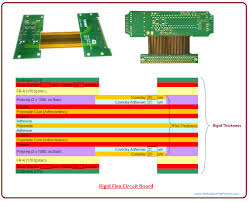
What materials are commonly used in rigid flex boards?
Once the PCB’s design is complete, it must undergo a rigorous testing and inspection to ensure it meets all necessary standards for its intended application. This testing includes evaluating its dimensional stability, thermal and heat resistance, electrical properties, and flexibility. During this phase, engineers can identify any potential issues with the structure and make adjustments before manufacturing begins.
In the past, rigid flex boards used adhesives between the flexible and rigid sections to ensure they stayed together. However, this method was not always effective. Adhesives can degrade over time, leading to a loss of elasticity and a decreased ability to withstand mechanical stress. Fortunately, advances in substrate materials and adhesives have improved the structural integrity of rigid flex boards.
The conductive portions of rigid flex circuit boards are made from copper, which is often used in both the flexible and rigid sections of the layer stack. Depending on the application, copper foil can either be electro-deposited or rolled. Both types of copper have varying characteristics that need to be taken into account, including their thickness, workability, and durability. They are also subject to chemical treatment during the fabrication process to reduce bond degradation, enhance adhesion, and prevent oxidation.
Rigid flex circuits are made from a mixture of materials, including FR-4, UL-rated laminates, and polyimide, a material that is highly flexible, durable, and has good thermal and electrical properties. They also have a range of different finishes, which can help to protect the circuit boards from corrosion and improve their appearance. In addition, the flex portion of a rigid-flex circuit can be coated with a variety of protective substances, like silicones or hot-melt glues, to provide additional strength and durability.